


Stainless Steel Trolley Supplier China: The Complete B2B Sourcing Guide for Industrial Buyers
Why Chinese Stainless Steel Trolley Suppliers Lead Global Industrial Procurement
If you are searching for a reliable stainless steel trolley supplier China-based, you are likely a procurement manager, factory engineer, or operations director in food processing, pharmaceuticals, or heavy manufacturing. Chinese manufacturers have become the dominant force in this category not because of low labor costs alone, but because they have vertically integrated stainless steel fabrication—from tube milling to robotic welding to surface passivation. This means a single factory can control wall thickness tolerances, weld penetration, and load testing, which are critical for repeated industrial handling. Unlike trading companies that outsource production, direct manufacturers in Guangdong, Zhejiang, and Jiangsu offer full traceability and faster customization. When you partner with a Chinese stainless steel trolley supplier, you gain access to OEM and ODM capabilities that support everything from standard 500 kg capacity platform trolleys to explosion-proof cleanroom carts. The key is knowing how to separate true manufacturers from middlemen, which we will cover in this guide.
Product Introduction: What Stainless Steel Trolleys Solve in Industrial Environments
A stainless steel trolley is a mobile material handling platform designed for transporting raw ingredients, work-in-progress parts, or finished goods across production floors, warehouses, and cleanrooms. Its primary purpose is not simply to move items, but to do so without introducing contamination, corrosion, or structural failure under continuous load. In food processing plants, for example, trolleys must withstand high-pressure washdowns with caustic detergents and 80°C water. Standard painted steel carts would rust within weeks. Stainless steel trolleys solve this by offering a non-porous, corrosion-resistant surface that meets FDA and EU food contact regulations. In electronics assembly, stainless steel avoids electrostatic discharge and particle shedding. The industrial value lies in reducing downtime: a reinforced trolley with sealed bearings can last 10+ years in three-shift operations, whereas low-grade carts fail every 6–12 months. Chinese manufacturers now produce trolleys with load capacities from 150 kg to 2,000 kg, with modular designs that accept customized shelving, drawers, and hitches.
Product Features: Structural Design, Material Advantages, and Performance Characteristics
Industrial buyers should look beyond “durable” claims. The real differentiators are in the details. First, frame construction: Chinese suppliers use 25 mm × 25 mm to 40 mm × 40 mm square tubes with 1.2 mm to 2.0 mm wall thickness. The reinforced corner gussets and cross-bracing improve load stability during repeated transportation and uneven floor transitions. Second, welding quality: robotic TIG welding ensures full penetration, then the entire frame is passivated with citric acid to restore the chromium oxide layer. Third, casters and wheels: industrial-grade polyurethane or nylon wheels with precision ball bearings, often with brakes and swivel locks. A common mistake is choosing a trolley with a 200 kg rated caster for a 500 kg load—Chinese manufacturers can supply casters rated at 2× the working load for safety. Fourth, surface finish: 2B, BA, or mirror polish. BA finish is standard for food and pharma; mirror polish is for cosmetics and semiconductor cleanrooms. Finally, ergonomic features: push handles at 900 mm height, anti-slip shelves, and drainage holes for liquid runoff.
Application Scenarios: Where Stainless Steel Trolleys Deliver ROI
Different industries demand different configurations. Below are the most common applications our factory serves for global B2B clients.
- Food processing: Trolleys with 304 stainless steel, fully welded, no crevices, and 100 mm polyurethane wheels for washdown areas. Used to move meat bins, vegetable crates, and finished packaged goods. Must pass HACCP and USDA requirements.
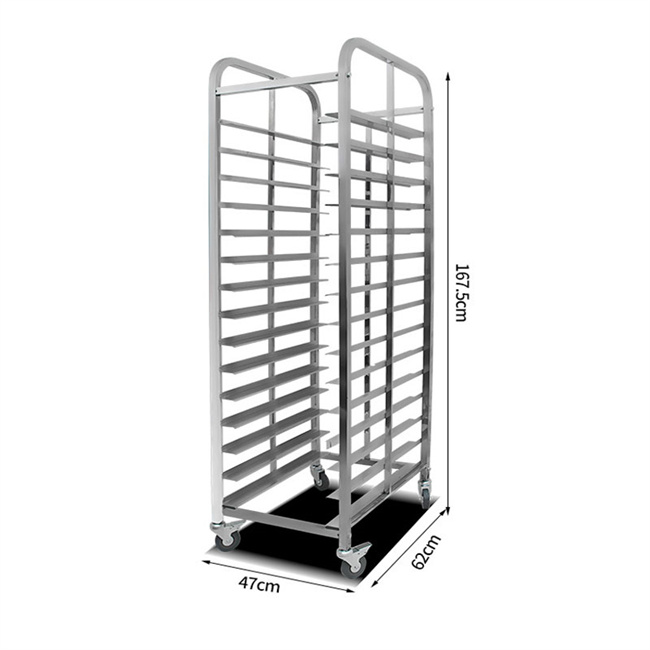
- Bakery: Multi-tier trolleys (10 to 20 shelves) for holding baking trays. Often with 201 stainless steel for cost-sensitive operations, but 304 is recommended for high-humidity proofing rooms.
- Industrial manufacturing: Heavy-duty platform trolleys with 1,000 kg capacity, reinforced with a 50 mm × 50 mm frame and 200 mm cast iron wheels. Used for die transport and assembly line feeding.
- Cleaning and sanitation: Trolleys with mop buckets, wringer attachments, and bag holders. 316 stainless steel is preferred for chemical plants and coastal facilities.
- Drying: Trolleys with perforated shelves or mesh trays to allow airflow. Often used in textile and paper mills.
- Storage and transportation: Nestable or foldable trolleys to save 60% space on return trips. Common in logistics hubs and cold chain warehouses.
For each scenario, the supplier must confirm the load distribution, wheel type, and cleaning method. A trolley that works in a dry warehouse will fail in a fish processing plant.
Material Selection: 304 vs 316 vs 201 vs Aluminum
Material choice directly affects service life and cost. Here is a practical comparison from a manufacturing standpoint.
- 304 stainless steel: The industry standard for food, beverage, and pharmaceutical. Contains 18% chromium and 8% nickel. Resists most organic acids and washdown chemicals. Not suitable for high-chloride environments (e.g., saltwater).
- 316 stainless steel: Adds 2–3% molybdenum for superior chloride resistance. Recommended for coastal plants, chemical processing, and medical sterilization. Typically 20–30% more expensive than 304.
- 201 stainless steel: Lower nickel (1–4%) and higher manganese. Offers moderate corrosion resistance at 30–40% lower cost. Often used for bakery racks and light-duty storage where humidity is controlled. Not recommended for wet or acidic environments.
- Aluminum: Lightweight (about 1/3 of steel) and naturally corrosion-resistant. Used for aerospace and electronics assembly where weight matters. But aluminum is softer and can dent under heavy impact; it also cannot be welded as easily as stainless steel.
As a manufacturer, we always ask clients: What is the cleaning agent? What is the ambient humidity? What is the maximum load? Based on that, we recommend the most cost-effective material, not the most expensive one.
Specification Parameters: What Industrial Buyers Must Confirm
When you request a quote from a Chinese stainless steel trolley supplier, provide these parameters to avoid rework. Below are the key specifications and typical options.
- Dimensions: Length × width × height. Common platform sizes: 900 × 600 mm, 1200 × 800 mm, 1500 × 750 mm. Custom sizes are available with a 7–10 day lead time.
- Thickness: Tube wall 1.2 mm, 1.5 mm, 2.0 mm. Shelf thickness 1.0 mm to 3.0 mm. Thicker is not always better—over-thick shelves add weight and cost without improving load capacity if the frame is weak.
- Capacity: 150 kg, 300 kg, 500 kg, 800 kg, 1,000 kg, 2,000 kg. Always specify the dynamic load (while moving) vs static load (stationary). Dynamic load is typically 50–60% of static load.
- Number of shelves: 1 to 5 for platform trolleys; up to 20 for tray trolleys. Shelf spacing must match your trays or bins.
- Load per shelf: Uniformly distributed load (UDL) is critical. A 500 kg trolley with 3 shelves may only support 150 kg per shelf.
- Hole diameter and mesh size: For perforated shelves, 5 mm, 8 mm, 10 mm holes. For mesh, 25 × 25 mm or 50 × 50 mm openings. Choose based on small parts or liquid drainage.
- Tray compatibility: If you use standard 600 × 400 mm bakery trays, confirm the shelf spacing and retaining lips. Chinese suppliers can adjust to any tray standard (Euronorm, Gastronorm, etc.).
- Surface treatment: 2B (matte), BA (bright annealed), mirror polish (No. 8), or electropolished. Electropolishing improves corrosion resistance and reduces particle adhesion for cleanrooms.
Customization Services: OEM/ODM Capabilities from Chinese Factories
One of the strongest advantages of working with a Chinese stainless steel trolley manufacturer is flexibility. Most factories offer:
- Custom size and design: Provide a drawing or sample; we can reverse-engineer and produce a prototype in 5–7 days.
- Logo and branding: Laser etching, screen printing, or metal tags on the frame or handle.
- Packing: Custom carton printing, foam inserts, or wooden crates for sea freight. We can also do drop-test certified packaging for e-commerce.
- Special requirements: Explosion-proof wheels for paint booths, ESD-safe casters for electronics, autoclave-sterilizable designs for hospitals, and foldable or nestable frames for space-saving logistics.
For custom requirements, please contact our team with your drawings or application details. We will respond within 24 hours with a feasibility assessment and a quote.
Procurement Guide: How to Choose the Right Supplier and Specification
Buying stainless steel trolleys from China can be highly profitable, but only if you avoid common pitfalls. Here is a step-by-step guide based on our experience with hundreds of B2B clients.
- How to choose the size: Measure your narrowest aisle, door width, and turning radius. Add 100 mm clearance. Also consider the largest item you will transport—the trolley deck should be at least 50 mm larger on each side.
- How to choose the material: 304 for 80% of industrial applications. Choose 316 only if chlorides or harsh chemicals are present. Choose 201 only for dry, indoor, light-duty use. Never choose 201 for food processing.
- How to confirm specifications: Ask for a detailed drawing with tolerances. Request a material certificate (Mill Test Report) for the stainless steel coil. Confirm caster brand and load rating. Ask for a load test video before shipment.
- How to judge supplier capability: Look for a factory audit report (ISO 9001, BSCI). Ask how many robotic welding stations they have. Request a video tour of the production line. A true manufacturer will have in-house tube cutting, bending, welding, polishing, and assembly. A trading company will not. Also check if they have experience with your industry—food, pharma, or automotive.
Finally, always order a sample or a small trial order before committing to a container load. A reputable supplier will support this.
Frequently Asked Questions (FAQ)
What is the typical lead time for a custom stainless steel trolley order from China?
For standard models, 15–20 days after deposit. For fully custom designs, 25–35 days including prototyping and approval. Sea freight to Europe or the US adds 25–40 days depending on the port. Air freight is available for urgent samples.
Can I mix 304 and 201 materials in one order to reduce cost?
Yes, but we do not recommend it for food or wet environments. Some clients use 304 for the frame and 201 for shelves in dry storage. However, dissimilar metals can cause galvanic corrosion if moisture is present. Always consult your supplier.
What is the minimum order quantity (MOQ)?
Most Chinese manufacturers require 50–100 units for standard trolleys. For custom designs, MOQ may be 200 units. However, some factories accept 10–20 units for trial orders at a higher unit price.
Do you provide load testing certificates?
Yes. We perform 1.5× static load tests and 1.2× dynamic load tests on every batch. We can provide a test report with photos and videos. Third-party inspection (SGS, TUV, BV) is also welcome.
How do I ensure the wheels are suitable for my floor?
For concrete or epoxy floors, use polyurethane wheels (quiet, non-marking). For tile or uneven floors, use nylon or rubber wheels. For cleanrooms, use ESD-safe or stainless steel casters. Always specify your floor type and any slopes or thresholds.
What surface finish is best for a pharmaceutical cleanroom?
Electropolished 316 stainless steel with a Ra < 0.8 μm surface roughness. This minimizes particle retention and allows effective cleaning with IPA or hydrogen peroxide. Mirror polish is not recommended because it can hide micro-scratches.
Can you add a logo and custom packaging?
Yes. We offer laser etching, screen printing, and metal nameplates. Custom packaging includes printed cartons, foam inserts, and wooden crates. We can also pack according to your retail or distribution requirements.
How do I contact a reliable stainless steel trolley supplier in China?
Start with a direct manufacturer, not a trading company. Check their factory address, request a video audit, and ask for references in your industry. For custom requirements, please contact our team—we will provide a free consultation and a detailed quote within one business day.
Image ALT Text Suggestions
For SEO and accessibility, use these ALT texts when publishing images:
- "Stainless steel trolley supplier China - 304 food grade platform trolley with 500kg load capacity"
- "Custom stainless steel bakery trolley with 20 shelves and 201 material"
- "Heavy duty 316 stainless steel trolley for chemical plant with polyurethane wheels"
- "OEM stainless steel trolley with laser etched logo and foldable frame"
SEO Meta Information
SEO Title: Stainless Steel Trolley Supplier China | Custom Industrial Trolleys
Meta Description: Source stainless steel trolleys from a Chinese manufacturer. 304/316 custom designs, 500kg+ capacity, OEM/ODM. Get a quote for your food or industrial plant.
SEO Keywords: stainless steel trolley supplier China, industrial trolley manufacturer, 304 stainless steel cart, custom trolley OEM, food grade trolley China, heavy duty platform trolley, stainless steel bakery trolley, 316 stainless steel cart, trolley factory China, B2B stainless steel trolley

