


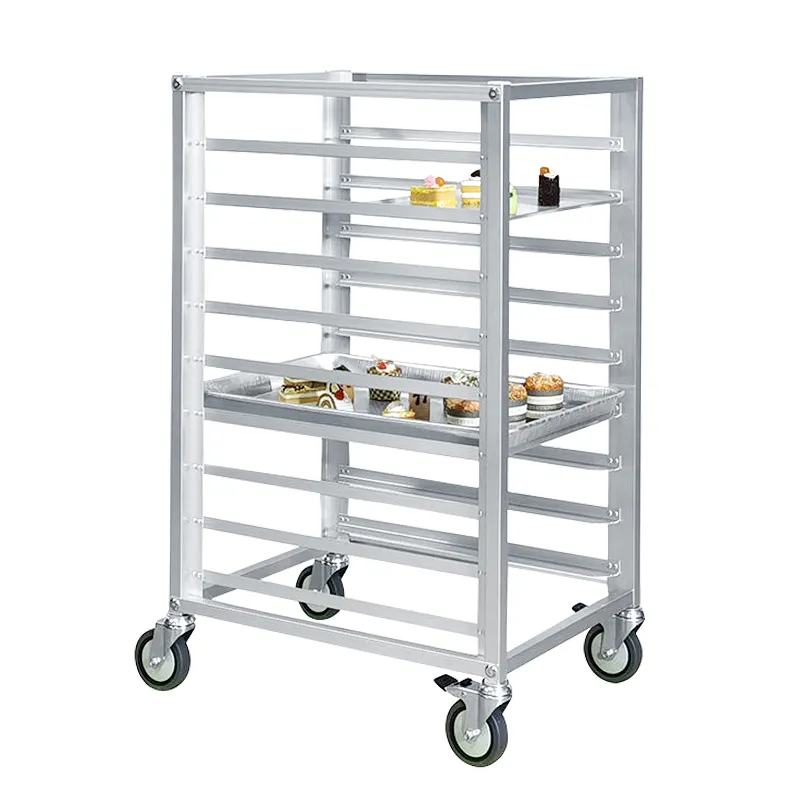
Stainless Steel Trolley Welding Process: A Procurement Guide for Food Equipment Quality Control
Product Introduction: What Is a Stainless Steel Trolley and Why Welding Matters
In food processing plants, bakeries, and industrial kitchens, a stainless steel trolley is not just a cart—it is a critical asset for transporting raw materials, finished goods, and waste. The stainless steel trolley welding process determines whether the trolley can withstand daily washdowns, heavy loads, and repeated sanitization. Poor welds create crevices that harbor bacteria, leading to hygiene risks and premature failure. As a manufacturer with over 15 years of experience serving European and North American food equipment distributors, we have seen how welding quality directly affects total cost of ownership. This article provides procurement professionals with actionable criteria to assess welding quality and choose the right supplier.
Product Features: Structural Design and Material Advantages
A well-engineered stainless steel trolley features a reinforced frame structure that improves load stability during repeated transportation and industrial handling. Unlike standard furniture, food-grade trolleys must resist corrosion from cleaning agents, high-pressure steam, and organic acids. Our trolleys use fully welded joints rather than tack welds, eliminating gaps where pathogens can accumulate. The welding process—typically TIG (Tungsten Inert Gas) or MIG (Metal Inert Gas)—is selected based on material thickness and application. For example, TIG welding provides superior control for thin-walled tubes, while MIG welding offers higher deposition rates for thicker frames. Key performance characteristics include:
- Load capacity: 150 kg to 500 kg, depending on design and caster selection.
- Corrosion resistance: Passivation after welding restores the chromium oxide layer, critical for 304 and 316 grades.
- Cleanability: Smooth, crevice-free welds meet NSF/ANSI 2 and EHEDG guidelines.
- Durability: Reinforced gussets at stress points extend service life in high-traffic areas.
Application Scenarios: Where Welded Stainless Steel Trolleys Excel
Different industries impose unique demands on trolley welding. In food processing, trolleys transport meat, dairy, and produce through washdown zones; welds must resist chloride-rich sanitizers. In bakery operations, trolleys hold racks of dough or baked goods, requiring heat resistance and easy cleaning of flour dust. Industrial manufacturing uses heavy-duty trolleys for parts handling, where impact resistance and load stability are paramount. Cleaning applications involve exposure to caustic chemicals; 316 stainless steel with post-weld passivation is often specified. Drying rooms demand trolleys that withstand high humidity and temperature fluctuations. For storage and transportation, trolleys must nest or stack efficiently, which depends on precise welding of frame components. A European distributor recently reduced replacement costs by 30% after switching to our TIG-welded trolleys with reinforced corner joints.
Material Selection: 304 vs. 316 vs. 201 Stainless Steel
Choosing the right material is as critical as the welding process itself. 304 stainless steel is the industry standard for food equipment, offering excellent corrosion resistance and formability. 316 stainless steel adds molybdenum for superior resistance to chlorides and aggressive chemicals, ideal for seafood processing or coastal environments. 201 stainless steel is a lower-cost alternative with reduced nickel content; it is suitable for dry storage but not for wet or acidic conditions. Aluminum trolleys are lightweight and corrosion-resistant but cannot be welded as easily as stainless steel and may not meet hygiene standards for direct food contact. For welding, 304 and 316 are readily weldable with TIG or MIG; 201 requires careful heat control to avoid cracking. Always request mill test certificates to verify material composition.
Specifications: Key Parameters for Procurement
When specifying a stainless steel trolley, buyers should focus on measurable criteria:
- Dimensions: Length, width, and height (e.g., 1200 x 800 x 900 mm) must fit doorways, racks, and washing tunnels.
- Thickness: Tube wall thickness (1.2 mm to 2.0 mm) and sheet thickness (1.0 mm to 1.5 mm) affect load capacity and weldability.
- Capacity: Static and dynamic load ratings; dynamic is typically 60-70% of static.
- Number of shelves: 2 to 5 tiers, with adjustable or fixed positions.
- Load capacity per shelf: 50 kg to 150 kg, depending on shelf design.
- Mesh size: For wire mesh shelves, aperture (e.g., 50 x 50 mm) and wire diameter (4-6 mm) impact airflow and cleaning.
- Surface treatment: Electropolishing, passivation, or mirror polishing to reduce bacterial adhesion.
- Caster compatibility: Bolt-hole patterns and wheel types (polyurethane, nylon, rubber) for different floor conditions.
Customization Services: OEM/ODM Capabilities
As a manufacturer with in-house welding and fabrication, we offer full OEM/ODM services. Custom sizes, shelf configurations, and load ratings are routine. We can integrate logo engraving or laser marking on frames. Custom packaging for sea freight, including edge protection and desiccant, prevents damage during transit. Special requirements such as anti-microbial coatings, static-dissipative casters, or HACCP-compliant designs are supported. Our engineering team reviews your application to recommend the optimal welding process—TIG for thin-wall hygiene, MIG for heavy-duty frames—and provides welding procedure specifications (WPS) and qualification records. For custom requirements, please contact our team to discuss your project.
Procurement Guide: How to Choose the Right Trolley and Supplier
Selecting a stainless steel trolley involves balancing technical needs with supplier reliability. Start by defining the load, environment, and cleaning regimen. For wet or acidic environments, specify 304 or 316 with post-weld passivation. For dry storage, 201 may suffice. Confirm specifications through a detailed drawing that includes weld symbols, material grades, and tolerances. Ask for weld quality documentation: visual inspection reports, dye penetrant testing for critical joints, and passivation certificates. To judge supplier capability, request a factory audit or video walkthrough of their welding stations. A competent manufacturer will have qualified welders (e.g., AWS D1.6 or ISO 9606-1) and calibrated equipment. Lead times, minimum order quantities, and after-sales support are also key. Remember that the lowest price often reflects thinner materials or skipped passivation—both false economies in food equipment.
Frequently Asked Questions (FAQ)
1. What is the difference between TIG and MIG welding for stainless steel trolleys?
TIG welding offers precise control and produces clean, high-quality welds ideal for thin tubes and hygienic applications. MIG welding is faster and better for thicker sections but may require more post-weld cleaning. The choice depends on material thickness and production volume.
2. Why is passivation necessary after welding?
Welding depletes chromium from the stainless steel surface, reducing corrosion resistance. Passivation removes free iron and restores the chromium oxide layer, crucial for food-grade equipment exposed to sanitizers.
3. Can I use 201 stainless steel for a food processing trolley?
201 is not recommended for wet or acidic food environments due to lower corrosion resistance. It may be acceptable for dry storage or non-food contact. Always verify with your hygiene officer.
4. How do I verify weld quality before shipment?
Request visual inspection reports, dye penetrant testing for critical welds, and passivation certificates. Third-party inspections like SGS or BV can also be arranged.
5. What load capacity can a stainless steel trolley handle?
Standard models range from 150 kg to 500 kg dynamic load. Custom heavy-duty designs can exceed 1000 kg. Always consider the weakest point, such as casters or shelf brackets.
6. Do you provide custom sizes and designs?
Yes, we offer full OEM/ODM services. Provide your drawings or requirements, and our engineers will propose a design with appropriate welding and materials.
7. What is the typical lead time for a custom order?
Lead time varies by complexity and quantity. Standard models ship in 4-6 weeks; custom orders may take 8-12 weeks. We provide a detailed schedule upon order confirmation.
8. How should I maintain a stainless steel trolley to prolong its life?
Clean regularly with mild detergent and water, avoid chloride-based cleaners, and inspect welds for cracks or corrosion. Periodic passivation every 6-12 months is recommended in aggressive environments.
Image ALT Text Suggestions
For product images, use descriptive ALT text that includes target keywords:
- "Stainless steel trolley with TIG-welded frame for food processing"
- "Close-up of hygiene-critical weld on stainless steel trolley"
- "Custom stainless steel trolley with mesh shelves and casters"
- "304 stainless steel trolley in bakery application"
- "Passivated welds on food-grade stainless steel trolley"
SEO Metadata
SEO Title: Stainless Steel Trolley Welding Process | Food Equipment Guide
Meta Description: Learn how stainless steel trolley welding process ensures food safety. Procurement guide for 304/316 trolleys, weld quality, custom manufacturing, and supplier selection.
SEO Keywords: stainless steel trolley welding process, food equipment welding, stainless steel trolley manufacturer, 304 stainless steel trolley, 316 stainless steel trolley, TIG welding food equipment, hygienic welding, custom stainless steel trolley, food-grade trolley supplier, trolley welding quality control

