


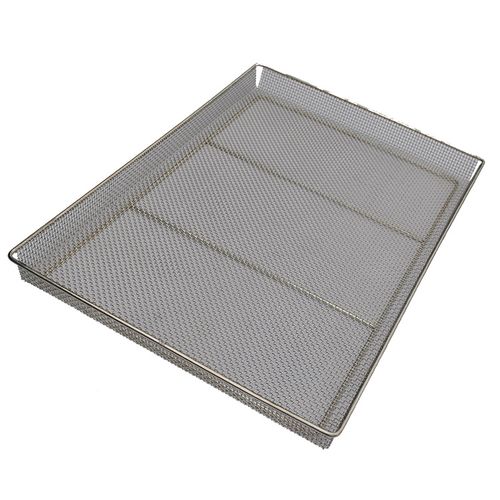
Stainless Steel Wire Mesh Tray: A Strategic Sourcing Guide for Industrial Buyers
Product Introduction
In the world of industrial processing, a stainless steel wire mesh tray is far more than a simple container. It is a critical component in production lines where hygiene, airflow, and load stability directly impact output quality and operational efficiency. Designed for continuous production environments, these trays are engineered to withstand repeated cycles of washing, drying, baking, and sterilization without compromising structural integrity.
From a manufacturer's standpoint, the industrial mesh tray solves several production problems simultaneously. It allows for uniform air circulation during drying, ensures safe handling of components during assembly, and provides a durable, corrosion-resistant surface for food contact. For procurement professionals, sourcing these trays is a strategic decision that affects operational uptime, product safety compliance, and long-term maintenance costs. Unlike consumer-grade products, industrial buyers require documentation, batch consistency, and the ability to scale production without variations in quality.
Product Features and Engineering Advantages
Our stainless steel mesh tray is built with a reinforced frame design that significantly improves load stability during repeated transportation and high-frequency industrial handling. The mesh surface is not merely a cost-saving measure; it is a functional element that facilitates rapid drainage, airflow, and heat transfer, which is essential in drying and cooling processes.
Key engineering advantages include:
- High corrosion resistance: The choice of stainless steel grade ensures the tray remains rust-free even in humid or chemically aggressive environments.
- Easy cleaning surface: The open mesh design prevents water pooling and allows for thorough cleaning, meeting strict hygiene standards.
- Stable load capacity: The wire diameter and mesh opening are calculated to support heavy loads without deformation, even under continuous use.
- Custom manufacturing options: Trays can be produced to exact dimensions, with specific mesh counts and edge treatments to fit existing equipment.
Manufacturing processes such as automated wire welding and precision bending ensure that each tray is consistent. The surface treatment, whether passivation or electropolishing, enhances the material's natural corrosion resistance and makes it suitable for pharmaceutical and food-grade applications.
Application Scenarios
The versatility of stainless steel mesh trays makes them indispensable across various industries. In food processing, they are used for drying vegetables, freezing meat, and smoking fish, where airflow and hygiene are paramount. Bakeries rely on them as commercial drying racks for pastries and bread, ensuring even cooling and preventing sogginess.
In industrial manufacturing, these trays serve as parts carriers during degreasing, coating, and ultrasonic cleaning. The mesh allows solvents and coatings to drain freely, reducing waste and improving finish quality. Pharmaceutical and laboratory environments use them for sterilizing instruments and drying glassware, where contamination control is critical. Additionally, they are used for storage and transportation of small components, where ventilation prevents moisture buildup and corrosion.
Each application benefits from the tray's ability to maintain structural integrity while providing maximum exposure to air or fluids. This is not a one-size-fits-all product; understanding the specific scenario is key to selecting the right specification.
Material Options and Manufacturing Details
Material selection is a primary decision for buyers. 304 stainless steel provides reliable corrosion resistance for food contact applications and daily industrial cleaning environments. It is the most common choice for general food processing and bakery use. 316 stainless steel offers superior resistance to chlorides and aggressive chemicals, making it suitable for pharmaceutical, marine, and chemical processing applications. While it costs more, it significantly extends service life in harsh conditions.
201 stainless steel is a cost-effective alternative for dry environments or light-duty applications where corrosion is not a primary concern. However, it is not recommended for wet or food contact applications. Aluminum trays are lightweight and offer good thermal conductivity, but they are less durable and not suitable for highly alkaline or acidic cleaning agents.
Manufacturing details such as wire diameter, mesh count, and frame thickness are tailored to the load and process requirements. For example, a tray used in a heavy-duty baking oven will have a thicker wire and reinforced edges compared to a tray used for drying small electronic components.
Specifications and Technical Parameters
When requesting a quotation, buyers should be prepared to specify the following parameters. Available sizes can be customized according to equipment dimensions and production requirements. Typical specifications include:
- Size: Custom dimensions based on oven or conveyor width.
- Thickness: Wire diameter from 1.0mm to 5.0mm; frame thickness from 3mm to 10mm.
- Capacity: Load capacity varies from 5kg to 50kg per tray depending on design.
- Layers: Single or multi-tier configurations available.
- Mesh opening: From 2mm to 50mm, depending on airflow and product size.
- Surface treatment: Passivation, electropolishing, or powder coating.
- Production tolerance: Typically ±1mm for dimensions, ensuring compatibility with existing racks.
These parameters ensure that the tray integrates seamlessly into your production line and performs reliably over time.
Custom OEM Manufacturing Service
As an OEM stainless steel tray manufacturer, we provide comprehensive custom manufacturing services. This includes custom size and design, logo marking for brand identification, special packaging for export, material selection guidance, prototype development, and bulk production. Our engineering team works with your specifications or helps develop a design from a sample or drawing.
For custom requirements, please contact our team. We handle projects from small-batch prototypes to large-volume orders, ensuring that every tray meets your exact operational needs. Our production lines are equipped to handle various wire diameters and mesh patterns, and we maintain strict quality control throughout the process.
Purchasing Guide for Industrial Buyers
Effective sourcing requires more than just comparing prices. Industrial buyers should consider the following:
- Confirm working environment: Is the tray exposed to moisture, chemicals, or high heat? This determines the material grade.
- Check material requirements: Ensure the stainless steel grade meets food safety or pharmaceutical standards.
- Verify equipment compatibility: Provide exact dimensions and load requirements to avoid costly retrofits.
- Evaluate supplier production capacity: Can they handle your volume and maintain lead times?
- Review quality control: Ask for material certificates, welding strength tests, and surface finish inspections.
- Consider export experience: A supplier familiar with international shipping and packaging reduces logistical risks.
- Packaging and delivery reliability: Ensure trays are packed to prevent damage during transit and that delivery schedules are realistic.
By addressing these points, procurement teams can avoid common pitfalls such as premature corrosion, load failure, and inconsistent dimensions that disrupt production.
常见问题
Q1: What stainless steel grade is recommended for food processing applications?
For food processing, 304 stainless steel is the standard choice due to its excellent corrosion resistance and compliance with food contact regulations. If the environment involves chlorides or aggressive cleaning agents, 316 stainless steel is recommended for longer service life.
Q2: Can the tray size be customized?
Yes, we manufacture trays to any custom size. Buyers should provide the exact dimensions required for their equipment, including length, width, and height, as well as any specific mesh opening or wire diameter preferences.
Q3: Do you provide OEM manufacturing service?
Absolutely. We offer full OEM services, including custom design, logo marking, special packaging, and material selection. Our team can develop prototypes based on your drawings or samples and then proceed to bulk production.
Q4: What information should buyers provide before quotation?
To provide an accurate quote, we need the tray dimensions, material grade, wire diameter, mesh opening, load capacity, surface treatment, and quantity. Any drawings or samples are helpful. Also, inform us of the application environment.
Q5: How do you control product quality?
We implement strict quality control at every stage: incoming material inspection, in-process checks during welding and forming, and final inspection for dimensions, surface finish, and load testing. Material certificates and test reports are available upon request.
Q6: What is the typical lead time for bulk orders?
Lead time depends on order quantity and customization. For standard sizes, it is typically 15-20 days. For custom OEM orders, it may be 25-35 days after sample approval. We will confirm the exact schedule upon order placement.
Q7: How are the trays packaged for export?
We use export-standard packaging: inner plastic film or foam to prevent scratches, then packed in strong wooden crates or pallets. Custom packaging with your logo is available. We ensure safe transport to your destination.

