


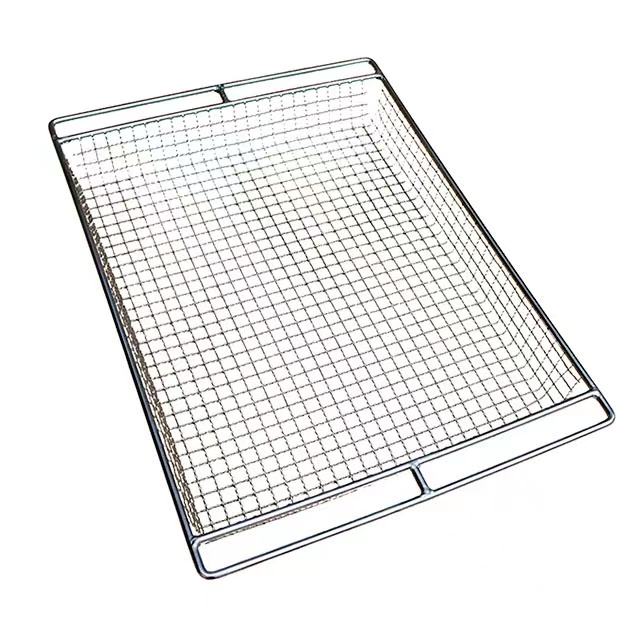
Stainless Steel Wire Tray Sourcing Guide for Industrial Buyers
Product Introduction
In industrial procurement, a stainless steel wire tray is not a generic accessory. It is a load-bearing, hygiene-critical component used in continuous production environments where product contact, airflow, drainage, and repeated handling directly affect output quality. For importers, distributors, and manufacturing engineers, the tray must meet equipment dimensions, survive daily washdowns, and maintain structural integrity under static and dynamic loads. This guide is written for B2B buyers who need to compare suppliers, confirm specifications, and reduce total cost of ownership rather than simply purchase a low-priced item.
A well-manufactured stainless steel wire tray solves several production problems at once. It allows uniform air circulation during drying, prevents product pooling during cooling, supports safe transport between processing stages, and simplifies cleaning in food, pharmaceutical, and laboratory settings. When buyers source without understanding wire diameter, mesh opening, or frame reinforcement, they often face premature deformation, corrosion at weld points, and costly line downtime. That is why this article focuses on procurement criteria, material selection, and OEM manufacturing capability.
Product Features and Engineering Advantages
The engineering value of an industrial wire tray comes from how it is built, not from marketing claims. A reinforced frame design improves load stability during repeated transportation and high-frequency industrial handling. Cross wires are typically resistance-welded or spot-welded to the frame, and the weld schedule must be controlled to avoid burn-through or weak joints. For heavy-duty applications, edge reinforcement or a thicker outer rod prevents deflection when the tray is loaded and moved on conveyor systems.
- High corrosion resistance for washdown and humid environments
- Easy cleaning surface with open mesh structure that reduces debris entrapment
- Stable load capacity through reinforced frames and controlled wire spacing
- Custom manufacturing options for equipment-specific dimensions
- Stackable or nesting designs for storage and transport efficiency
- Consistent surface treatment for food-contact and cleanroom requirements
Manufacturing details matter to procurement teams because they affect reject rates and line compatibility. The wire diameter, mesh count, and frame thickness must match the load profile and the cleaning method. If a buyer specifies a tray for a bakery oven or a food processing line, the design must tolerate thermal cycling and repeated exposure to detergents. In industrial manufacturing, the same tray may be used for parts washing, drying, or temporary storage, which requires different structural priorities.
Application Scenarios
Different industries purchase stainless steel wire trays for different reasons. In food processing, the tray must support raw or cooked product while allowing drainage and airflow. It must also withstand daily sanitation with alkaline or acidic cleaners. A food processing tray used in meat, seafood, or ready-meal production often requires 304 or 316 stainless steel and a smooth finish to reduce bacterial retention.
In bakery operations, trays are used for cooling, proofing, and transport. The mesh opening affects air circulation around bread and pastries, while the frame must remain stable when stacked. For industrial drying processes, a stainless steel drying tray is chosen for its open area and heat resistance. The tray must maintain flatness under heat so that products do not shift or fall during automated handling.
Cleaning and parts-washing applications require trays that resist chemical attack and support heavy components. Here, wire diameter and weld quality are more important than fine mesh. Pharmaceutical and laboratory buyers prioritize cleanability, dimensional tolerance, and material traceability. Commercial production lines often need custom stainless steel trays that fit existing racks, trolleys, or conveyor systems. Storage and transportation applications benefit from stackable designs that protect products and reduce handling damage.
Material Options and Manufacturing Details
Material selection is one of the most common sources of confusion in B2B procurement. 304 stainless steel provides reliable corrosion resistance for food contact applications and daily industrial cleaning environments. It is the default choice for most food processing, bakery, and commercial drying trays. 316 stainless steel offers higher resistance to chlorides and aggressive chemicals, making it suitable for pharmaceutical, laboratory, and some seafood processing applications where salt exposure is constant.
201 stainless steel is a lower-cost option with reduced corrosion resistance. It may be acceptable for dry storage or light-duty applications, but it is not recommended for frequent washdown or food-contact environments with acidic products. Aluminum trays are lightweight and cost-effective for some drying and baking uses, but they are softer and less corrosion-resistant than stainless steel. Buyers should match the material to the working environment, cleaning chemicals, and expected service life.
Manufacturing details also affect performance. Wire diameter typically ranges from 1.5 mm to 6 mm depending on load requirements. Mesh opening can be customized from small apertures for fine parts to wider spacing for airflow. Surface treatment may include pickling, passivation, electropolishing, or a simple polished finish. For food-contact trays, passivation is often recommended after welding to restore the protective oxide layer and improve corrosion resistance.
Specifications and Technical Parameters
Industrial buyers should confirm the following parameters before requesting a quotation. Available sizes can be customized according to equipment dimensions and production requirements. Tray thickness, wire diameter, and mesh opening should be specified in millimeters or inches, and tolerance should be agreed upon in writing. Load capacity should be stated as a distributed load and, if relevant, a point load. For stackable trays, the buyer should confirm stack height and nesting clearance.
- Size: length, width, and height based on equipment or rack dimensions
- Thickness: frame and wire thickness for load and durability
- Capacity: recommended distributed load per tray
- Weight loading: static and dynamic load limits
- Layers: single-layer or multi-tier configurations
- Mesh opening: customized for airflow, drainage, or part retention
- Wire diameter: selected according to load and handling frequency
- Tray compatibility: fit with existing trolleys, racks, or conveyors
- Surface treatment: passivation, polishing, or electropolishing
- Production tolerance: dimensional and flatness tolerances
When exact parameters are not available, buyers should provide the working environment, product weight, and equipment interface. A capable supplier will then propose a wire diameter and mesh configuration that balances strength, airflow, and cost. It is also important to confirm whether the tray will be used in a high-temperature oven, a freezer, or a chemical cleaning line, because each condition affects material and weld selection.
Custom OEM Manufacturing Service
For importers and distributors, OEM capability is often the deciding factor. A manufacturer that only offers standard sizes will struggle to support equipment-specific projects. A true OEM stainless steel tray manufacturer should provide custom size, custom design, logo marking, special packaging, material selection, prototype development, and bulk production. This allows buyers to build their own product line or supply private-label trays to industrial customers.
Prototype development is especially important for food processing and manufacturing companies that need to test fit and load performance before committing to volume. A capable factory can produce samples within a reasonable lead time and adjust wire diameter, frame reinforcement, or mesh opening based on test results. For custom requirements, please contact our team. Early involvement from the manufacturer often reduces redesign costs and prevents line compatibility issues.
Purchasing Guide for Industrial Buyers
Purchasing decisions should be based on total cost of ownership, not unit price alone. A lower-priced tray that deforms after a few weeks can cost far more in downtime, product loss, and replacement labor. Buyers should evaluate suppliers on quality control, production capability, export experience, packaging, and delivery reliability. A supplier with in-house wire drawing, welding, and surface treatment can control quality more consistently than a trading company that outsources every process.
- Confirm working environment: temperature, humidity, chemicals, and cleaning method
- Check material requirements: 304, 316, 201, or aluminum based on corrosion risk
- Verify equipment compatibility: dimensions, load points, and handling method
- Evaluate supplier production capacity: monthly output, equipment, and lead time
- Review quality control: weld strength, flatness, surface finish, and tolerance checks
- Agree on packaging: export cartons, pallets, or custom branding
- Confirm delivery reliability: production schedule, shipping terms, and documentation
For bulk orders, buyers should request a pre-production sample and a written inspection standard. If the trays are for food contact, ask for material certificates and passivation reports. If the order is for a specific production line, provide drawings or physical samples to avoid dimensional errors. A reliable supplier will welcome these requests because they reduce claim risk for both sides.
FAQ
What stainless steel grade is recommended for food processing applications?
For most food processing applications, 304 stainless steel is the standard choice because it offers reliable corrosion resistance and cleanability. If the tray is exposed to salt, chlorides, or aggressive sanitizers, 316 stainless steel is recommended. Buyers should confirm the cleaning chemicals and operating environment before selecting the grade.
Can the tray size be customized?
Yes. Most industrial tray manufacturers can produce custom sizes based on equipment dimensions, rack systems, or conveyor specifications. Buyers should provide length, width, height, and load requirements. A drawing or sample tray helps the factory match fit and tolerance accurately.
Do you provide OEM manufacturing service?
Yes. OEM service typically includes custom design, size, wire diameter, mesh opening, logo marking, and special packaging. Prototype development is available for new projects. Buyers should share application details and target volume so the manufacturer can recommend the right process and material.
What information should buyers provide before quotation?
Buyers should provide tray dimensions, material grade, wire diameter, mesh opening, load capacity, surface finish, and quantity. If the tray must fit existing equipment, a drawing or photo is helpful. The working environment and cleaning method also affect material and weld selection.
How do you control product quality?
Quality control usually includes incoming material inspection, weld strength checks, dimension and flatness measurement, surface finish inspection, and final packing review. For food-contact trays, passivation and material certificates may be provided. Buyers can request a pre-shipment inspection report.
What is the typical lead time for bulk orders?
Lead time depends on order quantity, customization level, and factory schedule. Standard trays may ship within 15 to 25 days after deposit, while custom OEM orders may require 25 to 40 days. Buyers should confirm the production schedule before placing a deposit.
How should trays be packaged for export?
Export packaging should protect the trays from deformation, moisture, and surface damage. Standard options include cartons, pallets, and shrink wrap. For OEM orders, custom labels and branded packaging can be arranged. Buyers should confirm packaging requirements in the purchase order.
Can trays be used in high-temperature ovens?
Stainless steel wire trays can be used in many baking and drying ovens, but the maximum temperature depends on the grade, wire diameter, and load. Buyers should confirm the oven temperature and cycle time. For high-temperature applications, a suitable stainless steel grade and reinforced frame are recommended.

