





The Ultimate Guide to Stainless Steel Food Trays for Food Factories, Central Kitchens, and Food Processing
Why Stainless Steel Food Trays Are Essential in Food Processing
In food factories, central kitchens, and experimental food processing, trays are workhorses. They carry raw ingredients, hold semi-finished products, and streamline cooking, cooling, and storage. The right tray reduces contamination risk, improves workflow efficiency, and lowers long-term replacement costs. Stainless trays for food have become the industry standard because they combine durability with cleanability. However, not all stainless trays are equal. Design details like edge geometry, surface finish, and drainage directly impact food safety and operational practicality. This article guides you through key specifications, application categories, and a checklist to evaluate suppliers effectively.
Material Matters: Choosing the Right Stainless Steel Grade
Material grade is the first decision. For most food contact surfaces, austenitic stainless steels like 304 and 316 are preferred. 304 stainless steel offers excellent corrosion resistance and formability, making it suitable for general food handling, baking, and storage. 316 stainless steel adds molybdenum, providing superior resistance to chlorides and acidic foods – ideal for high-salt or high-acid applications like marinating or seafood processing. 201 stainless steel is a cost-effective alternative, but its reduced corrosion resistance may not meet long-term hygiene standards in demanding environments. For food industry stainless steel trays, always verify the alloy composition and request mill certificates. In lightweight applications, aluminum alloy trays (1060, 3003, 5052) are sometimes used for rapid heat transfer, but they lack the durability and scratch resistance of stainless steel. If you prioritize longevity and hygiene, industrial stainless steel tray made from 304 or 316 is the recommended choice.
Edge Design and Corner Hygiene: Preventing Bacterial Traps
Microorganisms thrive in crevices and sharp corners. Therefore, tray edge design is critical. Seamless, fully welded corners with a minimum radius reduce bacterial harborage points. Avoid trays with folded seams or welded joints that are not ground smooth – these create hidden pockets where food residue accumulates. The ideal stainless steel food tray should have a one-piece construction or butt-welded and polished seams that are continuous and free from pits. For open-top trays, a rolled edge (hemmed edge) not only adds rigidity but also eliminates sharp edges that could injure workers or damage other equipment. Check that all edges are deburred and rounded – this improves both safety and cleanability.
Welding and Grinding: Achieving Smooth, Pore-Free Surfaces
Welds are common points of failure in hygiene. If a tray is welded (e.g., for reinforced corners), the weld must be fully penetrated, ground flush, and polished. A rough weld traps food and bacteria, making cleaning ineffective. Orbital welding is preferred for critical applications because it produces consistent, smooth welds. After welding, grinding and polishing restore the surface to a smooth, non-porous state. The goal is a surface roughness (Ra) of ≤ 0.8 μm for general food contact, though some applications require even finer finishes (≤ 0.4 μm). A smoother surface not only enhances cleanability but also resists corrosion and staining.
Surface Roughness: The Key to Effective Sanitation
Surface texture influences how easily soils and bacteria adhere. A rough surface provides microscopic hiding places – higher surface roughness (Ra) increases cleaning time and chemical usage. For stainless steel sheet trays used in food processing, specify a brushed or mirror finish with a Ra between 0.4 and 0.8 μm. This finish is smooth enough to prevent residue buildup yet practical for daily use. Also, consider the direction of the finish – a unidirectional grain is easier to clean than a random pattern. When ordering, request a surface roughness test report from the manufacturer, especially for trays in contact with unpackaged food.
Drainage Design: Facilitating Liquid Runoff
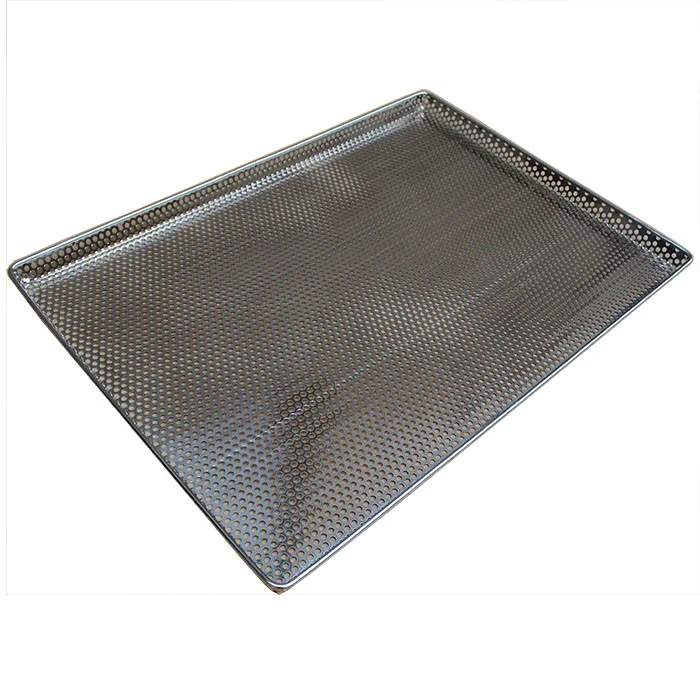
Trays often hold liquids – marinades, thawing water, or cooking juices. Proper drainage prevents pooling, which can lead to bacterial proliferation and uneven processing. Perforated trays (with holes) allow liquids to escape while holding solid food. Hole size and pattern are customizable – common diameters range from 1.5 mm to 10 mm, depending on the food type (e.g., small holes for diced vegetables, larger holes for whole chicken). For solid trays, a slight slope or raised edges can channel liquids to one corner for easy pouring. Consider a ribbed bottom to elevate food from the tray surface, improving air circulation and reducing sticking.
Stacking and Nesting: Maximizing Storage Efficiency
In busy food environments, space is premium. Trays should be designed for stable stacking to save floor space and ensure safe transportation. Look for trays with stacking lugs or ridges that prevent jamming and allow airflow between stacked trays – this is crucial for cooling or freezing. For transport, nesting capabilities (where empty trays slide into each other) reduce storage volume when not in use. But note: nesting can accumulate debris between trays, so ensure the design allows for easy cleaning. Evaluate the weight capacity – a reinforced rim or corner strengthens the tray against bending under heavy loads.
Cleaning Methods: Ensuring Trays Withstand Harsh Sanitation
Industrial trays are typically cleaned with high-pressure washers, chemicals, and steam. Therefore, the tray must withstand repeated exposure to hot water (up to 95°C), alkaline or acidic detergents, and chlorine-based sanitizers. Always confirm the tray's corrosion resistance to these agents – especially around welded areas. For automated washers, ensure the tray's dimensions and weight allow for proper conveyor transport. Ultrasonic cleaning may require a thicker material to prevent vibration damage. If trays are used in freezers or ovens, they must tolerate thermal shock – a thicker material (≥ 1.0 mm) helps prevent warping. Regular inspection for cracks, pitting, or rough spots is essential; any damage can compromise hygiene.
Traceability: Marking Trays for Production Control
In modern food industries, traceability is mandatory. Trays should be marked with laser-engraved labels containing serial numbers, material grade, or production dates. Unlike adhesive tags, laser engraving is permanent and withstands harsh cleaning. Marking can be placed on a flat edge or underside to avoid food contact. This enables batch tracking from raw material to finished product, aiding in quality control and recall procedures. When ordering, specify your marking requirements – such as logo or unique ID – and ensure the marking process does not create rough edges that affect hygiene.
Application Categories: From Central Kitchens to Experimental Labs
Central kitchens need trays for high-volume production – baking sheets, thawing trays, and transportation. They prioritize stacking, heat conduction, and durability. Food processing plants may use trays in conveyors, ovens, or freezers – requiring precise dimensions and heat resistance. Experimental and R&D facilities often need smaller, customizable trays for pilot runs, with easy cleaning and material traceability. The food industry stainless steel tray range includes:
Baking trays: Reinforced edges to prevent warping at high temperatures. Perforated trays: For drying, smoking, or draining. Solid trays: For marinating, freezing, or holding liquids. Transport trays: With lip edges and stacking lugs for safe handling.
Inspection Checklist: How to Audit Your Tray Supplier
Before purchasing, use this checklist to ensure quality:
Material certificate: Request a mill certificate verifying 304 or 316 grade. Surface finish test: Ask for Ra measurement data. Weld quality: Inspect for pits, cracks, or rough spots – use a magnifying glass or finger touch. Edge condition: Verify all edges are smooth and rounded. Dimensional tolerance: Check that length, width, and height meet your specifications (e.g., ±1 mm). Stacking test: Ensure trays stack securely without rocking. Weight capacity: Confirm the tray can withstand your maximum load without permanent deformation. Cleaning simulation: Ask for a warranty that covers damage from standard wash-down procedures.
FAQs
Q1: Can I use 201 stainless steel trays for food contact?While 201 is often used in budget applications, it offers lower corrosion resistance and may not withstand harsh cleaning chemicals or acidic foods. For food safety and longevity, we recommend 304 or 316 stainless steel – especially for continuous contact with food.
Q2: What is the ideal surface roughness for food trays?For most food applications, a Ra of ≤ 0.8 μm is recommended. A finer finish (≤ 0.4 μm) is better for high-hygiene environments like ready-to-eat food processing. Always ask your supplier for a roughness test report.
Q3: How do I choose between solid trays and perforated trays?Solid trays are suitable for marinating, freezing, or holding liquids. Perforated trays are ideal for drainage, air circulation, and roasting. The hole size and pattern depend on the food size and your process – customization is available.
Get the Right Stainless Steel Food Tray for Your Operation
Selecting the right industrial stainless steel tray is an investment in efficiency and food safety. We offer fully customizable trays – from size and thickness to hole patterns and surface finish. Our trays are precision-engineered for durability and hygiene, with laser-engraved traceability available. To discuss your requirements or request a quote, contact our B2B team now. Share your specifications, and we'll provide a tailored solution within 24 hours.