





The Ultimate Stainless Steel Tray Quality Inspection Guide: From Incoming Material to Final Packaging
Why Stainless Steel Tray Quality Inspection Matters
Stainless steel trays are workhorses in baking, food processing, and industrial settings. A flawed tray can lead to product contamination, equipment damage, or safety hazards. Implementing a robust stainless steel tray quality inspection process ensures consistency, longevity, and compliance with your operational needs. Whether you’re sourcing baking trays for a commercial kitchen or industrial trays for parts handling, a systematic inspection protocol protects your investment and your reputation.
Pre-Order Acceptance Criteria: The Critical First Step
Before any production run, it’s essential to define and agree upon acceptance criteria with your supplier. This includes specifications for material grade, dimensions, tolerances, surface finish, and allowable defects. Without clear agreements, disputes become likely, and quality can vary wildly. For custom stainless steel trays, these criteria are even more critical—document every requirement to avoid costly misunderstandings.
Incoming Material Inspection: Starting with the Right Foundation
The quality of the base material determines the final product’s performance. Inspect incoming sheets for material grade certification, surface condition, and thickness. Verify that the grade matches your order (e.g., 304 vs. 316 stainless steel) and that the surface is free from pits, rust, or rolling marks. Use a calibrated micrometer to check thickness at multiple points, ensuring it falls within your specified tolerance.
Dimensional Accuracy: Precision in Every Measurement
Measure the tray’s length, width, and height using calibrated tools. For perforated trays, also verify hole diameter, pitch, and opening pattern. Tolerances should align with your pre-agreed standards—for example, ±1 mm for overall dimensions and ±0.1 mm for hole placement. Mismatched dimensions can lead to poor fit in racks or ovens, causing operational inefficiency.
Flatness and Edge Quality: No Warping, No Sharp Edges
Place the tray on a flat surface to check for warping or twisting. Use a straightedge and feeler gauge to detect deviations. Unsafe edges, such as burrs or sharp corners, can cause injuries and damage products. Inspect edges and corners for smoothness, and ensure that any folded or hemmed edges are uniform and secure. For custom stainless steel trays, edge design must meet both functional and safety requirements.
Weld Seam Integrity: Strength and Uniformity
If the tray has welded joints (e.g., corners or handles), examine them for uniformity, absence of cracks, and smoothness. A weak or porous weld can compromise structural integrity. Check for proper penetration and that the weld bead is clean, with no discoloration or roughness that could harbor bacteria. In food applications, weld seams must be smooth and easy to clean.
Perforation and Burr Inspection: Clean Holes Without Sharp Edges
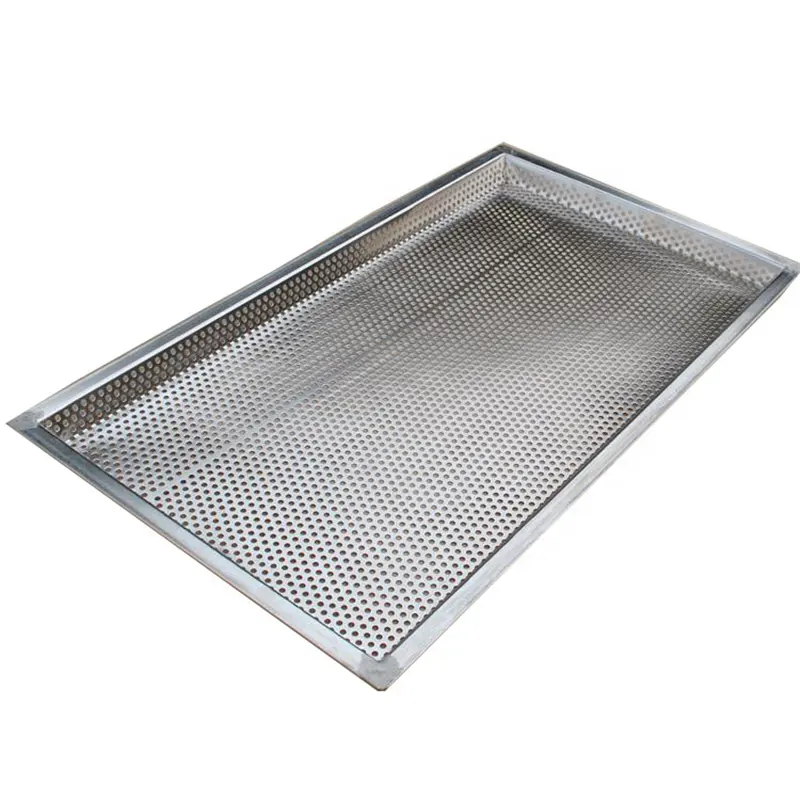
For perforated trays, inspect each hole for consistent diameter and clean edges. Burrs, which are raised edges around holes, must be removed to prevent scratching surfaces or injuring staff. Run a cotton swab or your finger along the edges to detect any roughness. For industrial tray inspection, burr-free holes are essential to prevent particle contamination in cleanroom environments.
Surface Scratch and Cleanliness Checks: Cosmetic and Hygienic Standards
Scratches can weaken the protective oxide layer and harbor bacteria. Inspect the surface under adequate lighting for scratches, dents, and other blemishes. Acceptable scratch depth and count should be defined in your acceptance criteria. Additionally, ensure the tray is free from oils, grease, or residues, especially for baking trays. Use a simple wipe test or solvent check to verify cleanliness levels.
Stacking and Packaging: Protection During Transit
Proper stacking prevents deformation and scratching during storage and transit. Test if trays nest securely without sticking, and that interleaving materials (like paper or foam) are used if required. Packaging should be robust enough to protect edges and corners. Check that packaging materials are food-grade if the trays are for direct food contact. For custom stainless steel trays, ensure the packaging accommodates their specific shape and size.
Sampling and Documentation: The Backbone of Quality Control
Implement a sampling plan based on your volume and risk tolerance. Use standard sampling techniques to randomly select trays from each batch for inspection. Record all results systematically—this includes dimensional measurements, defect counts, and photos. Documentation ensures traceability and provides evidence of compliance, which is vital for audits and continuous improvement.
Defect Classification Examples for Practical Guidance
To streamline inspections, classify defects into three categories: Critical, Major, and Minor. Critical defects include cracks, severe warping, or missing holes that make the tray unusable. Major defects include excessive burrs, deep scratches, or dimensional deviations beyond tolerance. Minor defects are cosmetic issues like faint scratches or slight discoloration that don’t affect function. Use a simple table to guide inspectors.
Common Questions About Stainless Steel Tray Inspection
Q: How often should I inspect incoming trays?
For high-volume orders, inspect every batch. For lower volumes, consider a sampling plan with at least 10% of the shipment.
Q: Can I use a magnet to check stainless steel grade?
No, magnet tests are unreliable. Always require material test certificates from the supplier.
Q: What is the best way to clean trays before inspection?
Use a mild detergent and non-abrasive cloth, then wipe with a solvent like isopropyl alcohol to remove oily residues.
Q: How do I handle borderline defects?
Refer to your pre-agreed acceptance criteria. If no criteria exist, consult with your supplier to determine next steps—this underscores the importance of setting standards upfront.
Final Thoughts on Quality Assurance
A thorough stainless steel tray quality inspection process is not just about rejecting bad products—it’s about building a partnership with your supplier. By clearly defining standards, inspecting systematically, and documenting results, you ensure that every tray performs as expected. Whether you’re implementing baking tray quality control for your bakery or industrial tray inspection for a factory, these practices will save time, reduce waste, and enhance safety.