





Ultimate Guide to Stainless Steel Tray OEM: From Custom Design to Mass Production
Introduction to Stainless Steel Tray OEM
In the world of industrial and commercial applications, stainless steel tray OEM plays a pivotal role in delivering tailored solutions for diverse needs. Whether you require a custom metal tray for food processing, an OEM baking tray for commercial kitchens, or an industrial stainless steel tray for manufacturing lines, the OEM process ensures precision, durability, and efficiency. This article walks you through every stage—from initial requirements to mass production—highlighting key technical aspects like materials, tolerances, and finishing.
Applications and Customization Options
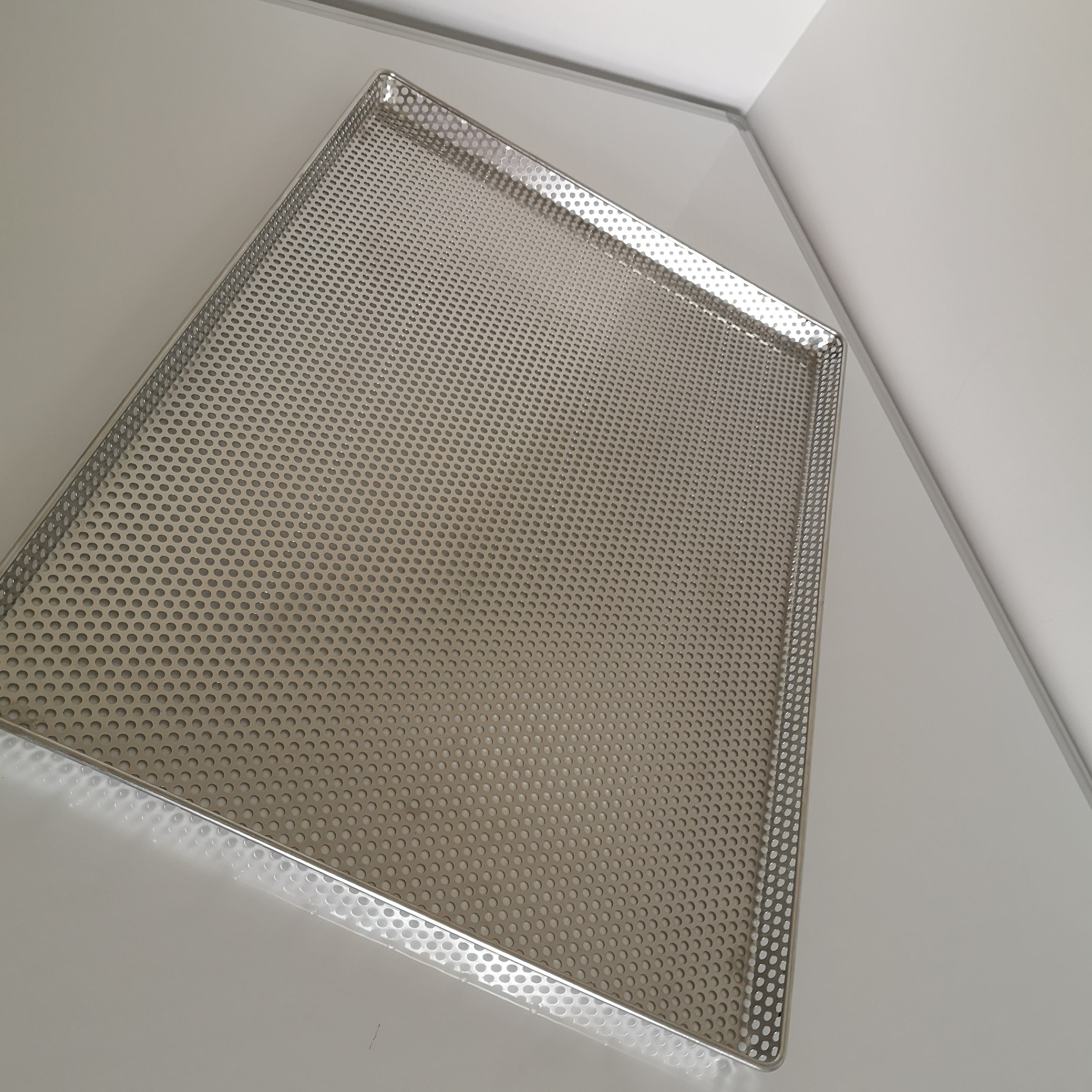
Stainless steel trays are used in countless industries: baking ovens, drying systems, sterilization units, and material handling. Customization begins with defining the application environment—temperature, chemical exposure, load-bearing needs, and hygiene standards. For instance, custom sheet pan for bakeries may require food-grade 304 stainless steel with specific hole patterns for airflow, while industrial trays might need 316 for corrosive environments. Dimensions are fully adjustable: common sizes range from 400×300 mm to 800×600 mm, with custom length, width, and edge height. Sheet thickness options span 0.5 mm to 2.0 mm, balancing weight and strength.
RFQ and Initial Consultation
The OEM journey starts with a detailed Request for Quotation (RFQ). Key fields include: material grade, sheet thickness, dimensions (L×W×H), edge design (flat, rolled, or wire-reinforced), hole diameter and arrangement, quantity, surface finish (e.g., #4 brushed, mirror), and tolerance requirements. The RFQ also asks for any third-party certifications (FDA, NSF) or special packaging needs. A precise RFQ ensures accurate quoting and avoids revision cycles. For example, specifying a tolerance of ±0.5 mm on critical dimensions and ±1° on bend angles helps manufacturers select the right processes.
2D/3D Drawing and Engineering
Once the RFQ is accepted, the supplier creates 2D/3D CAD drawings. These drawings detail every aspect: hole layout patterns, bend radii, weld joint locations, and edge treatments. For trays with perforations, the hole pattern is crucial—options include staggered, straight-line, or custom arrays, with hole diameters commonly from 1 mm to 10 mm. The open area percentage affects airflow and weight, often optimized at 30-50%. Engineers also simulate bending to ensure minimum bend radius (typically equal to material thickness) to prevent cracking. Drawings are shared digitally (PDF, STEP, IGES) for approval before prototyping.
Sample Development and Tolerances
Prototyping is vital. The manufacturer produces a sample using the exact materials and processes intended for mass production. This sample is checked against the drawings for dimensional accuracy. Standard tolerances for stainless steel trays: ±0.5 mm for dimensions up to 600 mm, ±1.0 mm for larger sizes; hole center distances ±0.2 mm; edge flatness ≤2 mm over 1000 mm. The sample also verifies material grade via spectroanalysis and surface finish using a gloss meter. Any deviations are corrected before approving the sample, which serves as the benchmark for bulk production.
Material Selection and Thickness
Choosing the right material is paramount. Common grades: 201 stainless steel (economical, suitable for dry environments), 304 (food-grade, corrosion-resistant, ideal for baking), and 316 (superior resistance to chlorides, used in marine or chemical settings). Aluminum alloys like 1060, 3003, or 5052 are lightweight alternatives offering fast heat conduction—great for custom sheet pan where handling ease matters. Sheet thicknesses range from 0.5 mm (light-duty trays) to 2.0 mm (heavy-load industrial racks). The choice impacts cost, weight, and lifespan; for example, a 1.0 mm 304 tray balances durability and affordability for most bakery use.
Fabrication Processes
Fabrication involves several steps: laser cutting or stamping to outline the tray, CNC punching for precise hole patterns, sheet bending to form edges and corners, and welding where required (e.g., joining side walls). For trays with bend radii, the machine settings must match the material’s ductility; typically, the inside radius equals material thickness. Welding methods like TIG or spot welding ensure strong, clean joints, especially for food-contact surfaces. After welding, areas are ground and polished to eliminate crevices that harbor bacteria.
Surface Finishing and Polishing
Surface finish is not just aesthetic—it impacts hygiene and corrosion resistance. Common finishes include #4 brushed (fine lines, easy to clean), mirror polish (reflective, for decorative uses), and bead blasting (matte, hides fingerprints). Polishing removes scale and weld discoloration, passivates the surface, and enhances chromium oxide layer. For OEM baking trays, a smooth finish prevents sticking and simplifies cleaning. The chosen finish should be specified in the RFQ, as it affects cost and lead time.
Marking, Packaging, and Quality Control
Identification is crucial for traceability. Options include laser engraving, chemical etching, or adhesive labels with logos, part numbers, and manufacturing dates. Packaging must protect the trays during transit: stacking with protective paper or foam, using corrugated boxes or wooden crates, and securing with straps. Quality control checks occur at multiple stages: incoming material inspection, in-process checks (dimensions, hole alignment), and final inspection per acceptance standards like ISO 9001. Each batch includes a Certificate of Compliance (COC) with mechanical and chemical properties.
Project Workflow (Text Version)
1. RFQ submission → 2. Feasibility review and quote → 3. Design approval (2D/3D) → 4. Sample production → 5. Sample evaluation and confirmation → 6. Mass production → 7. Final QC and packaging → 8. Shipping and documentation. This linear workflow ensures transparency and accountability, with milestones for client input.
Frequently Asked Questions (FAQ)
Q1: What is the minimum order quantity (MOQ) for custom sheet pan?
MOQ typically starts at 100 pieces, but many OEM suppliers offer lower MOQs for prototypes. For custom sizes and branding, MOQ may increase to 500 units.
Q2: Can I get a sample before mass production?
Yes, samples are usually provided after design approval. There may be a sample fee, which is often credited toward the first production order.
Q3: How are tolerances ensured during mass production?
We use precision CNC machines and conduct 100% inspection for critical dimensions. Statistical Process Control (SPC) monitors production consistency.
Q4: Do you provide custom packaging with my brand?
Absolutely. We offer custom printing on boxes, polybags, and labels. For international shipping, we recommend sturdy wooden pallets.
Q5: What is the typical lead time?
For standard trays, 15-20 days after sample approval. For complex designs, 25-30 days. Expedited shipping is available at extra cost.
Q6: Can you assist with design for manufacturability?
Yes, our engineering team reviews your drawings to suggest improvements in hole patterns, bend radii, and material usage to reduce costs.
Meta Information
Meta Title: Stainless Steel Tray OEM | Custom Metal Tray & OEM Baking Tray Manufacturer
Meta Description: Explore the OEM process for stainless steel trays: custom design, materials, tolerances, fabrication, and QC. Ideal for industrial stainless steel tray buyers. Get a quote today!
Keywords: stainless steel tray OEM, custom metal tray, OEM baking tray, industrial stainless steel tray, custom sheet pan.
Call to Action
Ready to start your custom tray project? Contact us now for a free consultation and quote. Our experienced team will guide you from RFQ to delivery, ensuring your custom metal tray meets exact specs. Request a sample today!