


Wire Baking Tray Sourcing Guide for Industrial Buyers
Product Introduction
In industrial baking and food processing environments, the wire baking tray is not simply a surface for holding dough—it is a critical component that directly affects product consistency, oven airflow, and operational efficiency. These trays are typically constructed from welded stainless steel wire or mesh, designed to withstand repeated thermal cycling, mechanical handling, and rigorous sanitation protocols. For B2B buyers, selecting the right wire baking tray means balancing load capacity, heat transfer performance, and long-term corrosion resistance against total cost of ownership. Unlike consumer-grade baking sheets, industrial wire baking trays must maintain structural integrity through thousands of production cycles, often across conveyorized baking lines where dimensional accuracy and flatness are non-negotiable. This guide is written for importers, distributors, and industrial buyers who need to make informed procurement decisions rather than rely on generic product descriptions.
Product Features and Engineering Advantages
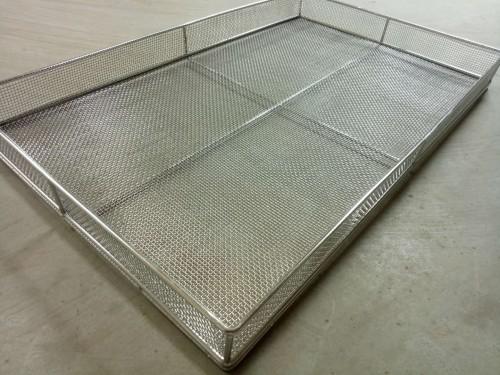
The engineering value of an industrial wire baking tray lies in its construction details. A typical high-quality tray features a reinforced frame—often formed from a heavier gauge wire—that resists deformation during repeated loading and unloading. Cross wires are spaced to provide uniform support for baked goods while allowing optimal air circulation, which is essential for even baking and drying. The welding process matters: spot welding or full welding must be controlled to avoid weak joints that fail under thermal stress. Surface treatment, such as passivation or electropolishing, enhances corrosion resistance and simplifies cleaning. In continuous production environments, trays are often subjected to automated washing systems, so the choice of stainless steel grade and weld quality directly impacts service life. Key features to evaluate include:
- High corrosion resistance for food-contact and wash-down environments
- Easy cleaning surface to meet hygiene standards
- Stable load capacity under repeated handling and thermal cycling
- Custom manufacturing options to match conveyor or rack dimensions
- Consistent mesh opening for airflow and product support
These features are not marketing claims—they are measurable attributes that procurement teams should verify through samples and production audits.
Application Scenarios
Wire baking trays are used across multiple industries, each with distinct requirements. In food processing, trays must comply with food-safety regulations and withstand frequent cleaning with caustic or acidic detergents. Bakeries rely on trays that maintain flatness to ensure even browning and prevent product tipping on conveyor lines. Industrial manufacturing may use wire mesh trays for parts drying or curing, where chemical resistance and load stability are paramount. In drying processes, whether for fruits, vegetables, or industrial components, the open mesh design facilitates uniform airflow and moisture removal. Cleaning processes often involve trays that hold parts during ultrasonic or spray cleaning, requiring robust construction and resistance to cleaning agents. Storage and transportation applications demand trays that stack securely and resist bending under load. Pharmaceutical and laboratory settings require trays with precise mesh openings and smooth surfaces to prevent contamination. Commercial production lines, from confectionery to ready meals, depend on trays that integrate seamlessly with automated handling systems. In each scenario, the wire baking tray is selected not for its appearance but for its ability to perform reliably under specific operational stresses.
Material Options and Manufacturing Details
Material selection is a primary cost and performance driver. 304 stainless steel is the workhorse grade for food-contact applications, offering reliable corrosion resistance in daily cleaning environments and good formability for complex wire shapes. 316 stainless steel provides superior resistance to chlorides and acidic conditions, making it suitable for seafood processing or facilities using aggressive sanitizers, though at a higher cost. 201 stainless steel is a lower-cost option with adequate corrosion resistance for dry or less demanding environments, but it may not withstand frequent wash-downs as well as 304. Aluminum trays are lightweight and offer excellent thermal conductivity, but they are prone to oxidation and are generally not recommended for acidic foods or harsh cleaning chemicals. Manufacturing details such as wire diameter, mesh count, and weld integrity are equally important. A reputable manufacturer will control wire diameter tolerances to ensure consistent airflow and structural strength. The welding process—whether resistance welding or TIG welding—must be validated to prevent wire pull-out under load. Surface treatments like passivation remove free iron and enhance the natural oxide layer, while electropolishing can further improve cleanability and appearance. Buyers should request material certificates and, where possible, conduct salt-spray testing to verify corrosion resistance.
Specifications and Technical Parameters
Industrial wire baking trays are rarely off-the-shelf items; they are typically customized to fit specific oven or conveyor dimensions. Key parameters to define include:
- Size: Length, width, and corner radius to match equipment
- Wire diameter: Typically ranging from 1.5 mm to 6 mm, depending on load requirements
- Mesh opening: The spacing between wires, which affects airflow and product support
- Thickness: Overall tray height, including frame and cross wires
- Load capacity: Static and dynamic load ratings, often expressed in kg per tray or per linear meter
- Surface treatment: Passivation, electropolishing, or coating
- Production tolerance: Dimensional allowances, typically ±1 mm for critical dimensions
When specific parameters are not provided, buyers should specify the operating environment, load requirements, and cleaning method to allow the manufacturer to recommend suitable specifications. It is common for trays to be designed with reinforced edges and intermediate supports to prevent sagging under heavy loads.
Custom OEM Manufacturing Service
For buyers seeking a long-term supply partner, OEM manufacturing capability is essential. A capable wire baking tray manufacturer should offer:
- Custom size and design based on drawings or samples
- Material selection guidance to balance cost and performance
- Logo marking for brand identification or traceability
- Special packaging to protect trays during ocean freight
- Prototype development to validate fit and function before mass production
- Bulk production with consistent quality control
When evaluating an OEM supplier, request examples of previous custom projects and ask about their production capacity, lead times, and quality assurance procedures. A factory that specializes in wire mesh products will have dedicated welding and forming equipment, which translates to better dimensional consistency and fewer defects. For custom requirements, please contact our team to discuss your application and receive a tailored quotation.
Purchasing Guide for Industrial Buyers
Effective procurement of wire baking trays requires a structured approach. Start by confirming the working environment: temperature range, cleaning chemicals, and load conditions. Then verify equipment compatibility—tray dimensions must match oven or conveyor slots, and stacking features must align with storage racks. Material requirements should be clearly specified, including grade and surface finish. Evaluate supplier production capacity by requesting a factory audit or video walkthrough, and check their export experience to ensure they understand packaging and documentation requirements. Quality control is critical: ask for inspection reports, material certificates, and samples for physical testing. Packaging must protect trays from deformation and surface damage during transit, and delivery reliability should be confirmed through references or past shipment records. A checklist for buyers:
- Confirm working environment and cleaning method
- Check material requirements and certifications
- Verify equipment compatibility and dimensional tolerances
- Evaluate supplier production capacity and quality control
- Review packaging and delivery terms
- Request samples for performance validation
FAQ
Q1: What stainless steel grade is recommended for food processing applications?
304 stainless steel is the standard choice for most food processing applications due to its balance of corrosion resistance and cost. For environments with high chloride exposure or aggressive cleaning agents, 316 stainless steel is recommended. Always verify that the material meets relevant food-contact regulations.
Q2: Can the tray size be customized?
Yes, most industrial wire baking trays are custom-made to fit specific equipment. Provide detailed drawings or samples, including dimensions, wire diameter, and mesh opening. Custom sizes help optimize oven loading and airflow.
Q3: Do you provide OEM manufacturing service?
We offer full OEM services including custom design, material selection, logo marking, and special packaging. Our engineering team can work from your drawings or develop a prototype for approval before bulk production.
Q4: What information should buyers provide before quotation?
Buyers should provide tray dimensions, material grade, wire diameter, mesh opening, load requirements, surface treatment, and estimated annual quantity. Application details such as operating temperature and cleaning method also help us recommend the most suitable specification.
Q5: How do you control product quality?
We implement incoming material inspection, in-process checks during welding and forming, and final dimensional and surface inspection. Material certificates and inspection reports are available upon request. We also welcome third-party inspections.
Q6: What is the typical lead time for bulk orders?
Lead time depends on order quantity and customization complexity. For standard custom trays, production usually takes 25–35 days after sample approval. We will confirm the schedule at the time of order.
Q7: How are trays packaged for export?
Trays are typically stacked with interleaving protection, wrapped in stretch film, and packed in wooden crates or reinforced cartons. We can customize packaging to meet your requirements and ensure safe ocean transit.

