


Woven Wire Mesh Tray Sourcing Guide for Industrial Buyers
Product Introduction
In industrial procurement, a woven wire mesh tray is not a commodity item picked from a catalog. It is a critical component designed for continuous production environments where hygiene, load stability, and long-term operational reliability directly affect throughput and maintenance costs. These trays are manufactured by interweaving metal wires into a uniform mesh structure, then reinforced with a frame to withstand repeated handling, high temperatures, and chemical exposure. For B2B buyers, the sourcing decision impacts not only unit cost but also downtime, product contamination risk, and compliance with industry standards. Whether you are an importer distributing to food plants or an engineering company specifying components for a drying line, understanding the manufacturing variables behind a woven wire mesh tray is essential. This guide approaches the product from a procurement perspective, covering engineering advantages, material selection, custom OEM capabilities, and the questions every buyer should ask before placing a bulk order.
Product Features and Engineering Advantages
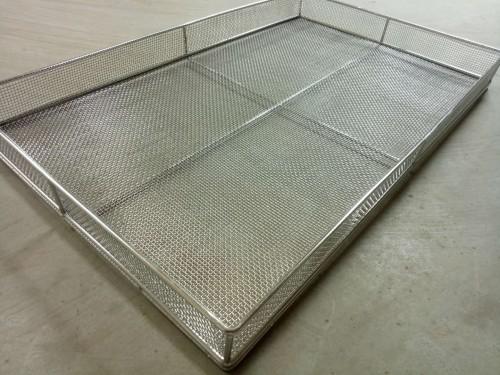
A woven wire mesh tray is engineered around three core requirements: structural integrity under load, open-area ratio for airflow or drainage, and surface cleanliness. The manufacturing process begins with wire selection—diameter, material grade, and tolerance—followed by precise weaving, edge preparation, and frame welding or crimping. Unlike perforated sheet trays, the woven structure provides a higher open area with less weight, which reduces energy consumption in drying and cooling applications. The reinforced frame design improves load stability during repeated transportation and high-frequency industrial handling. Cross-wire support rods are often added to prevent sagging under heavy loads or at elevated temperatures.
Key engineering advantages include:
- High corrosion resistance when specified with 304 or 316 stainless steel wire
- Easy cleaning surface with no trapped crevices, suitable for wash-down environments
- Stable load capacity through uniform wire spacing and reinforced frame construction
- Custom manufacturing options for non-standard equipment dimensions
- Consistent mesh opening to ensure uniform airflow and drainage across the tray surface
For industrial buyers, these features translate into fewer replacements, lower product loss, and easier validation during supplier audits. The tray must also resist deformation during automated handling, conveyor transitions, and repeated stacking. A supplier with in-house weaving and frame fabrication can control tolerances more tightly than a trading company outsourcing multiple processes.
Application Scenarios
Woven wire mesh trays are used across industries where open structure, hygiene, and durability are non-negotiable. In food processing, they carry vegetables, meat, and seafood through washing, blanching, freezing, and drying lines. The open mesh allows water and steam to pass through quickly, reducing processing time. In bakery production, they support bread, pastries, and biscuits during cooling and freezing, where uniform airflow prevents condensation and sogginess.
In industrial manufacturing, these trays hold small parts during degreasing, coating, and heat treatment. The mesh structure allows chemicals and air to reach all surfaces, improving process consistency. Drying processes in chemical, ceramic, and textile production rely on woven trays for uniform air circulation and minimal product marking. Cleaning processes in pharmaceutical and laboratory settings require trays that withstand autoclaving and solvent exposure without shedding particles.
Storage and transportation applications use stacked mesh trays to protect components while allowing ventilation. In pharmaceutical and laboratory environments, stainless steel woven trays are chosen for their non-reactive surface and ability to be sterilized repeatedly. Commercial production facilities, from large-scale catering to electronics assembly, depend on these trays for consistent performance across shifts. Each application demands a specific balance of mesh opening, wire diameter, and material grade—making the buyer's specification role critical.
Material Options and Manufacturing Details
Material selection is the single most important decision after tray dimensions. 304 stainless steel provides reliable corrosion resistance for food contact applications and daily industrial cleaning environments. It is suitable for most drying, baking, and general manufacturing processes where exposure to mild chemicals and moisture is expected. 316 stainless steel offers higher resistance to chlorides, acids, and marine conditions. It is preferred in pharmaceutical, chemical, and coastal food processing facilities where 304 would pit or corrode over time.
201 stainless steel is a lower-cost alternative with moderate corrosion resistance. It is sometimes used for non-food industrial trays where cost pressure is high and the environment is dry. However, buyers should verify that 201 meets their cleaning chemical compatibility. Aluminum trays are lightweight and offer good thermal conductivity, making them suitable for baking and cooling applications where corrosion is not a primary concern. They are not recommended for caustic cleaning or high-moisture environments.
Manufacturing details also affect performance. Wire diameter typically ranges from 0.8 mm to 3.0 mm depending on load requirements. Mesh opening can vary from 2 mm to 25 mm. Frame construction may be welded, crimped, or reinforced with cross rods. Surface treatment options include pickling, passivation, and electropolishing for pharmaceutical-grade cleanliness. Buyers should request material certificates and, where applicable, food-contact compliance documentation.
Specifications and Technical Parameters
Industrial buyers should confirm the following parameters before requesting a quotation. Available sizes can be customized according to equipment dimensions and production requirements, but standard ranges help frame the discussion.
- Size: Common tray dimensions range from 400 × 600 mm to 800 × 1200 mm. Custom sizes are available for specific oven, conveyor, or rack systems.
- Thickness: Wire diameter typically 0.8–3.0 mm; frame thickness may be 3–8 mm.
- Capacity: Load capacity depends on wire diameter, mesh opening, and support structure. Typical static loads range from 5 kg to 50 kg per tray.
- Weight loading: Buyers should specify maximum load per tray and whether loads are static or dynamic.
- Layers: Single-layer trays are standard; multi-layer stackable designs are available for space-efficient drying and storage.
- Mesh opening: 2 mm to 25 mm, depending on airflow, drainage, and product size requirements.
- Wire diameter: 0.8 mm to 3.0 mm.
- Tray compatibility: Trays can be designed to fit existing racks, ovens, and conveyor systems.
- Surface treatment: Pickled, passivated, or electropolished.
- Production tolerance: Dimensional tolerance typically ±1–2 mm; mesh opening tolerance ±5%.
Buyers should also clarify edge finish, corner radius, and whether stacking feet or handles are required. These details affect safety, handling efficiency, and equipment compatibility.
Custom OEM Manufacturing Service
For importers and distributors, OEM manufacturing is often the difference between a generic product and a market-ready solution. A capable woven wire mesh tray manufacturer should offer custom size, custom design, logo marking, special packaging, material selection, prototype development, and bulk production. This means the supplier can work from your drawings, samples, or performance requirements rather than forcing you into a fixed catalog.
Prototype development is especially valuable for engineering companies and food processing plants testing new production lines. A supplier with in-house weaving, frame fabrication, and surface treatment can shorten lead times and maintain consistency across production runs. Logo marking and custom packaging help distributors build brand recognition in their local markets. For custom requirements, please contact our team to discuss your specifications, target volumes, and delivery schedule.
Purchasing Guide for Industrial Buyers
Sourcing woven wire mesh trays requires more than comparing unit prices. The following checklist helps procurement teams evaluate suppliers and avoid costly mistakes:
- Confirm working environment: Identify temperature range, humidity, cleaning chemicals, and load type.
- Check material requirements: Verify whether 304, 316, 201, or aluminum is appropriate for your application.
- Verify equipment compatibility: Provide exact dimensions, rack interface, and handling method.
- Evaluate supplier production capacity: Confirm in-house weaving, welding, and surface treatment capabilities.
- Review quality control: Request material certificates, dimensional inspection reports, and sample approval before mass production.
- Assess export experience: Check packaging standards, documentation, and previous export markets.
- Clarify packaging and delivery: Confirm carton strength, pallet configuration, and lead time.
- Discuss after-sales support: Establish a process for handling defects or specification deviations.
For bulk orders, buyers should request pre-production samples and schedule third-party inspections if needed. A supplier that welcomes audits and provides transparent production updates is generally a safer long-term partner.
Frequently Asked Questions
Q1: What stainless steel grade is recommended for food processing applications?
304 stainless steel is the standard choice for most food processing applications due to its reliable corrosion resistance and food-contact suitability. If your facility uses chloride-based sanitizers or operates in a high-humidity coastal environment, 316 stainless steel is recommended for better pitting resistance. Always confirm compliance with your local food safety regulations and request material certificates from the supplier.
Q2: Can the tray size be customized?
Yes. Most woven wire mesh tray manufacturers offer custom sizes based on your equipment dimensions, rack system, or conveyor specifications. Provide exact length, width, height, and any corner radius or handle requirements. Custom sizes typically require a prototype or drawing approval before bulk production. Lead times for custom sizes are usually longer than standard models, so plan accordingly.
Q3: Do you provide OEM manufacturing service?
Yes. OEM service typically includes custom size, design, logo marking, special packaging, material selection, and prototype development. For distributors and importers, OEM manufacturing helps differentiate your product line and meet specific customer requirements. Provide your drawings, samples, or performance specifications, and the supplier can develop a production plan accordingly.
Q4: What information should buyers provide before quotation?
Buyers should provide tray dimensions, material grade, wire diameter, mesh opening, load capacity, operating temperature, cleaning method, and quantity. If the tray must fit existing equipment, include interface dimensions or a sample. The more technical details you provide, the more accurate the quotation and the lower the risk of specification mismatch during production.
Q5: How do you control product quality?
Quality control should cover incoming wire inspection, mesh weaving tolerance checks, frame welding strength, dimensional verification, surface treatment inspection, and final packaging review. Suppliers should provide material certificates, dimensional reports, and pre-shipment inspection photos. For critical applications, third-party inspection is recommended. A documented quality process is a strong indicator of supplier reliability.
Q6: What is the typical lead time for bulk orders?
Lead time depends on order quantity, customization level, and material availability. Standard trays may ship in 15–25 days after order confirmation. Custom sizes or special surface treatments can extend lead time to 30–45 days. Buyers should confirm production schedules before committing to delivery deadlines, especially for seasonal or project-based procurement.
Q7: How should woven wire mesh trays be packaged for export?
Export packaging should protect the mesh from deformation and surface damage. Trays are typically stacked with interleaving material, secured with strapping, and packed in reinforced cartons or wooden crates. For long-sea transit, moisture protection and palletized loading are recommended. Buyers should confirm packaging specifications with the supplier before shipment.
Q8: Can you supply samples for evaluation?
Most manufacturers provide samples for evaluation, though sample costs and freight may apply. For custom designs, a pre-production sample is strongly recommended before bulk manufacturing. Buyers should test the sample for fit, load capacity, cleaning, and durability under actual operating conditions. Sample approval is a critical step in the procurement process.

